Sunday, 20 July 2014

Moore Rodin, Compton Verney Gallery, Warwickshire (15 February-31 August 2014)


To celebrate its tenth anniversary, Compton Verney Gallery, which is set in a former privately-owned stately home and parklands in Warwickshire, is host to a major exhibition comparing the work of two giants of sculpture – Auguste Rodin and Henry Moore.  Collaborating with The Henry Moore Foundation and Musée Rodin, the exhibition features five Moore and six Rodin sculptures in its grounds, with a larger selection of smaller pieces and drawings displayed throughout the gallery’s rooms.


In a similar vein to the Ashmolean’s Bacon/Moore exhibition which closed in January, this collection also draws parallels in the use of the human figure in each artist’s work.  However, while Bacon/Moore timelines and experiences of the Second World War overlapped, Moore/Rodin were separated by an age gap of fifty-eight years (Moore was nineteen when Rodin died in 1917).
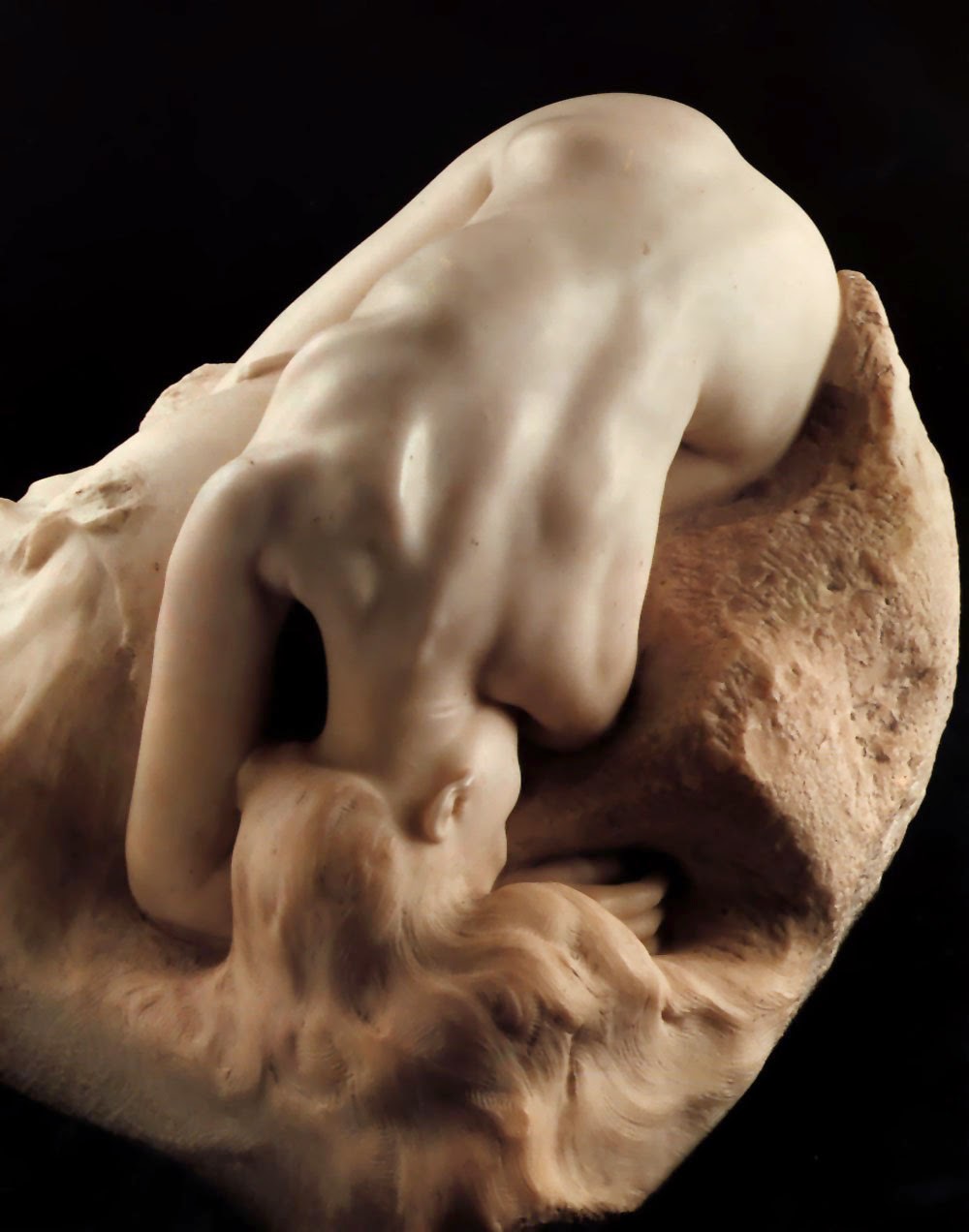
 
Danaid, Rodin (1885)
 
Working Model for Mother and Child, Upright, Moore (1978)
 
The juxtaposition of large pieces of sculpture (particularly Moore’s modernist pieces) against architecture and gardens such as at Compton Verney are always a delight for the eyes.  Here though, the gardens overwhelm the pieces on display and could have benefitted from a greater number within the grounds – the delight in discovering the pieces was over immediately as all the others were always within eyesight.  Inside the gallery the selection of sculptures worked much more successfully.  Alongside both sculptors finished pieces and maquettes an additional display case demonstrated how Moore and Rodin were collectors of antiquities and found objects which reflected their contrasting working methods - Moore was drawn to African, Oceanic, pre-Columbian and Cycladic sculpture, while Rodin concentrated on collecting classical antiquities.
Rodin’s intense scrutiny of the form (invariably female) bear rich fruit in his torso studies which show every taunt muscle and clearly reflect his interest in classical sculpture, while Moore’s abstracted heads can also be traced back to his interest in Oceania.
 Torso of Young Woman with Arched Back, Rodin (1909)
 
Head, Moore (1984)
Bizarrely when visiting sculpture exhibitions, I am always equally as fascinated by any associated drawings as the sculptures themselves.  I find the link between a sketched idea and the finished creation, or in fact any drawing by an artist who predominately works in 3D, strangely compelling.


The Artist's Hands, Moore (1974)        The Cathedral, Rodin (1908
 
Walking around this exhibition, it quickly became apparently how familiar most of the work on display was, which made me realise how fortunate I have been in my access to such wonderful artworks.  I have been lucky enough to visit Musée Rodin and The Henry Moore Foundation Hertfordshire where the artists lived and worked and are home to the majority of the work here.  If this exhibition ignites (or rekindles) an interest or love in Moore and Rodin, then a visit to Perry Green and Paris should definitely be next.

Jenny Saville: Oxyrhynchus, Gagosian Gallery (13 June-26 July 2014)


Intertwine (2011-2014)
 
Jenny Saville is for me, the greatest living figurative painter today.  While various theories still abound on the positioning of figurative painting within contemporary art practice, Saville’s skill and virtuosity with any tool she picks up cuts across the majority of such theories with the sheer force of her talent.  It is almost inconceivable that in a career spanning twenty years, this is the first-ever solo exhibition of her work in London.  Some critics have said that Saville labours a little too much on the duality of the fleshiness of the female body and the nature of paint of canvas and indeed, I found the mother and child subject matter of her exhibition at Modern Art, Oxford a little bit too essentialist, but when her paintings are executed so marvellously, it should be as easy to allow her such obsessions as we do other artists with their own.

Odalisque (2012-2014)
 
The distinction between painting and drawing is always blurred in Saville’s art and several of the pieces on display here show her characteristic collisions of charcoal, pastel and oil on canvas.  Her subject matter remains predominantly the female form, but surely in paintings such as Olympia (2013-2014) and Odalisque (2012-2014), Saville is playing with art history depictions of the lone, passive female nude displayed for a male audience as rendered by artists such as Manet and Matisse.  Saville subverts such depictions by again showing us very real women now joined by their lovers before, during or after sexual intercourse.  These women are autonomous agents within the sexual act, sometimes completely absorbed, sometimes even bored – it is a reality, rather than a fantasy which Saville gives us here.     
Olympia (2013-2014)

In the same way Saville’s mark marking has previously captured the horror and pain of surgical procedures, here she captures sexual energy.  The splashing and dripping of her paint act as metaphors for bodily fluids being exchanged. 
In The Realm of Mothers, III (2014)
These paintings are explicit, but never fall into the pornographic.  The mix of photorealism and abstraction cement Saville into the canon of painters which continues to be re-written by the inclusion of more and more female artists and this will always be a positive revision.  

Monday, 5 May 2014

Richard Deacon, Tate Britain, London (5 February-27 April 2014)


Lock, 1990
 
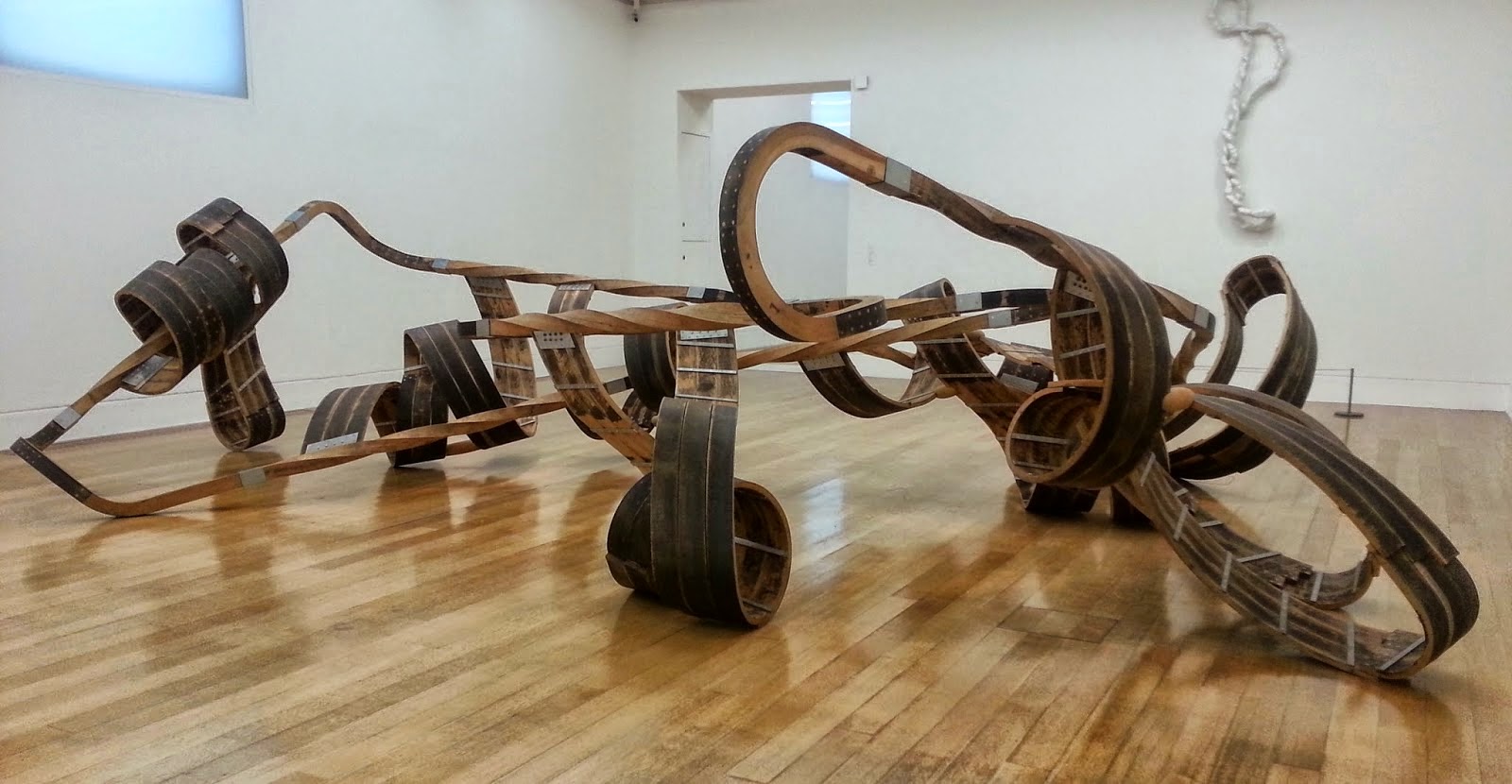
Richard Deacon has been working for over forty years and spawned a generation of art student imitators. Tate Britain’s enormous basement galleries are perfect spaces to show Deacon’s oversized sculptures, allowing them to command the rooms without being claustrophobic and overbearing.  This exhibition charts the artist’s career from a series of drawings made in 1978 and which in effect set the artist on a continuing pathway of discovering and exploration around notions of mass, volume and space. 
It's Orpheus When There's Singing #7, 1978-79
Untitled, 1981
 
Laminated wood and steel predominate throughout Deacon’s oeuvre.  The mix of steel rivets and  bolts juxtaposed against patterned and untreated wood with dried glue oozing out of the joints offer a visual feast of materials.  As with most large scale sculptural work, the urge to touch and caress is replaced by an urge to climb onto or crawl into Deacon’s serpentine shapes.  Despite being open in form, the viewer is restricted walking around and looking into his sculptures.  However, such restrictions still offers up wonderful mini installations/compositions – fantastic sketching opportunities for art students!

Struck Dumb, 1988

The scale of Untitled, 1981 hints at an early hands on approach as the artist developed his working method, which slowing became less and less as the scale of his work increased, to be replaced by Glasgow shipbuilders in Struck Dumb, 1988.  The artist (and studio hands) reappear in component works such as After, 1998. 
Mammoth, 1989
 
After, 1998

Deacon has never tired of his play of interior and exterior space and surprisingly, for such masculine looking work in terms of scale and choice of materials, the traditionally feminine-associated serpentine shape also predominates.  This interaction of sensuous composition and hard materials on the whole work very well.  However, perhaps the combination had become a little too formulaic in later pieces such as Out of Order, 2003 which for me is just too forced, too curvilinear, too over-complicated, over-decorated.  Just because you can steam word into a curve, shouldn’t mean that ever single plank must receive the same treatment in the same sculpture!

 
Out of Order, 2003

Along with Richard Wentworth, Richard Deacon is regarded as a leading British sculptor and key figure within New British Sculpture since the end of the 1970s. This exhibition was the first time I have viewed a large collection of the artist’s work, and unlike last year’s Wentworth retrospective at The Royal Academy, left me wanting to see more of his work.

Saturday, 8 March 2014

Hannah Höch, Whitechapel Art Gallery, London (15 January-23 March 2014)


It never ceases to amaze me when I visit a solo exhibition of a deceased female artist being held in a public gallery or museum to discover it is the first time their work has been shown in such an institution.  It happened twice last year with Marie Laurencin at Musée Marmottan Monet and Pauline Boty at Wolverhampton Art Gallery.  Hannah Höch died in 1978 and that this first retrospective of her work is taking place thirty six years after her death, demonstrates the disparity which still exists in bringing to the public’s attention such artists who are as equally deserving a their more-famous and more frequently exhibited male peers.


Höch was the Sarah Lucas of her generation – a no-nonsense, uncompromising and deeply committed artist.  Politically motived as well as experimental, she is credited as being the driving force in the development of collage in the twentieth century.  As an active member of the German Dada movement of the 1920s, her photomontages (as they were referred to then) questioned the nature of beauty, gender relations, race and institutional power. 


Of the one hundred works on display at the Whitechapel it is her work between 1925 and 1935 in an extended series entitled “From an Ethnographic Museum” in which she juxtaposed images of women taken from fashion magazines with ethnic masks and objects to comment on gender and racial stereotypes, which really demonstrate the artist at the peak of her conceptual and aesthetic  powers. 


Höch’s vision, politics and working practice has resonated with a number of subsequent artists, such as Martha Rosler and continues to resonate today in the work of contemporary artists (Wangechi Mutu springs instantly to my mind), which demonstrates the legacy her work has left.  Some reviews of this exhibition have referred to it as the first “must see” of the New Year and I completely agree.  The number of people crowded into the galleries while I was visiting, appear to agree too.


Wednesday, 1 January 2014

Francis Bacon and Henry Moore: Flesh and Bone, Ashmolean Museum of Art and Archaeology, Oxford (12 September 2013 - 16 January 2014)

 
(L) Henry Moore: King and Queen ( 1952-53)
(R) Francis Bacon: Lying Figure in a Mirror (1971)

The premise of this collection of work by two giants of twentieth century British art is to show the parallels in their practice despite their use of different mediums and perspectives on the human figure, from Moore’s modernist approach and belief in humanism and Bacon’s expressionism and nihilist view of the world.  Both were affected by their experiences of the Second World War and although they only met on a handful of occasions and never worked together, from the end of the War to the late 1960s their work was frequently exhibited together.  This exhibition is a contemporary reflection of this coming together and is perhaps the most amazing exhibition I have seen this year.   An indication of the impact of their work together first appears with the grouping of Bacon’s Portrait of Henrietta Moraes (1963) and Moore’s Falling Warrior (1956-57).  Both pieces are so confidently and magnificently executed that viewing them together is a sheer joy to my eyes and the  juxtaposition of Bacon’s large scale visceral and sculptural paintings alongside Moore’s emotionless monoliths which continues in the next room, is simply jaw dropping.
(L) Francis Bacon: Portrait of Henrietta Moraes (1963)
(R) Henry Moore: Falling Warrior (1956-57)

However, it was in the second room, named ‘Monumental Forms’, which was the gift which just kept giving.  After the initial impact of entering a room full of large sculptural pieces which are usually seen outside, the curatorial vision behind the installation of the work ensured that additional and unexpected Bacon/Moore combinations could be discovered by walking around the sculptures and view finding new and exciting composition s from around the room – Moore’s Woman (1957-58) placed in front of Bacon’s Untitled (Kneeling  Figure) (1982) offered an equally compelling view of Bacon’s Three Studies for Figures at the Base of a Crucifixion (1944) if viewed from the back of the sculpture – her elongated neck mirrored those in Bacon’s painting.   

 
(T) Francis Bacon: Three Studies for Figures at the Base of a Crucifixion (1944)
(B) Henry Moore: Woman (1957-58)
 
There were also plenty of other smaller pieces which were equally intoxicating, from Bacon’s pastel and pencil on paper Studio Interior (1936) and Moore’s The Helmet (1939-40).  While Bacon never undertook any sculpture work, Moore’s preparatory sketches and shelter drawings  completed in London Underground shelters during the Second World War while acting as an official war artist, demonstrate his two dimensional abilities.

 
 (T) Francis Bacon: Studio Interior (1936)
(B) Henry Moore: The Helmet (1939-40)

Whilst this exhibition is not unique in presenting the work of these two behemoth artists to compare and contrast their work and re-evaluate their legacy, it strength lies in its ability in bringing together a collection of work where every piece is at the same high level of artistic vision and execution by both artists.  Neither comes out of the aesthetic fight the weaker and the emotional intensity bound up in every canvas and bronze ensured that the last exhibition I visited in 2013, was the very best.  

Sunday, 29 December 2013

Facing the Modern: The Portrait in Vienna 1900, The National Gallery, London (9 October 2013-12 January 2014)

 
Gustav Klimt: (L) Portrait of a Lady in Black, c. 1895
(R) Portrait of Hermine Gallia, 1904
 
Gustav Klimt and Egon Schiele feature heavily in this exhibition at The National Gallery and as you walk through the galleries it is their work which consistently jump from the walls and grab your attention.  Even with contemporary eyes their work appears wonderfully alive and vibrant and so must have seemed incredibly daring and controversial at the turn of the twentieth century.  The two paintings above by Klimt demonstrate not only the artist's incredible talent but also the artistic transition from salon realism to individual artist expressionism and the clash of artistic traditions which was taking place in Vienna at that time.
 
"Portraiture was the genre most closely associated with the flourishing of modern art in Vienna in the years around 1900.  Artists focused on the image of the individual, working to the demands of patrons from the city's burgeoning middle classes.  From the commemorative to the critical, the cautious to the radical, their portraits charted the changing fortunes of men, women and children facing the distinctly modern challenge of living in one of the most diverse cities of its time". [from Gallery Guide]
 
Schiele's edgy portraits and self-portraits rendered in his language of scratchy, diseased-looking, elongated figures are a reflection of the artist's vision and extension of his own persona, rather than actual depictions of the sitters themselves.  While they confounded many critics at the time and appeared to reflect all that was deemed abject and degenerate for many, Schiele's self-portraits in particular were hugely popular and eagerly collected by his peers and other artists and intellectuals.
 
Egon Schiele: (L) Self Portrait with Raised Shoulder, 1912
(R) Portrait of Erich Lederer, 1912
 
Inevitably within all contemporary reviews of art movements the issue of female artists being excluded from art historical accounts has been re-addressed here with the inclusion of work by Broncia Koller, Teresa Ries and  Elena Luksch-Makowsky, who represent a small proportion of the women who regularly exhibited at the Secession and all who had careers as public artists in Vienna.  Koller was a member of  the Klimt Group and a high profile figure at the centre of Viennese intellectuals, artists and musicians.  Ries was once one of Vienna's most famous and successful artists and much sought after for portrait commissions.  The directness of her gaze and confidence exuding from her self-portrait of 1902 in which she portrays herself in a simple work smock typifies the notion of the New Woman - a purposeful, independent, self-sufficient and modern. 
 
Ries's depiction of her artistry and creativity is however in stark contrast to Luksch-Makowsky whose symbolist meditations permeated throughout her work and her self-portrait with her son has been read to suggest that childbirth was the ultimate creative act.  This view has been subsequently challenged by many feminist critics and may in part be why her name has been forgotten.
 
Ultimately though, the period of erasure, murder and emigration in the Austria-Hungary empire around the two World Wars and the treatment its Jewish population ensured that these artists, along with many others who were Jewish, were lost to art history records for many years and have been among the last women artists to be rediscovered.  Vienna in the 1900s reflected the ambivalent modernism of most capital cities of the time which offered unparalleled opportunities for women while at the same time continued to display misogyny towards them.  Koller, Ries and Luksch-Makowsky are three artists such women who had careers as public artists, their own studios, received commissions and exhibited regularly but whose names are virtually unknown today.


Bronica Koller: Nude Portrait of Marieta, 1907
 
Bronica Koller: Silvia Koller with a Bird Cage, 1907-08
 
 
Teresa Ries: Self Portrait, 1902
 
Elena Luksch-Makowsky: Self Portrait with her Son Peter, 1901
 
Turn of the twentieth-century Vienna had a fascination with death.  From death masks and death bed paintings, the notion of the 'beautiful corpse' was also celebratory.  Two paintings by Klimt show the public and private manifestation of deathly obsessions.  The hauntingly beautiful Ria Munk on her Deathbed was a commission from the deceased's family who wanted to commemorate the loss of their 24 year old daughter, who committed violent suicide (she shot herself in her heart) after the end of a love affair.  Klimt's intimate drawing of his dead son, Otto who died suddenly at just one year old demonstrates the artist's fascination with death both privately and publically. 
 
Gustav Klimt: (L) Ria Munk on her Deathbed, 1912
(R) Portrait of the Artist's Dead Son Otto Zimmermann, 1902
 
The new Viennese featured in this exhibition (both on and behind the canvases) reflect the intense, somewhat dark and unsurprisingly (given this was the age of Freud and analysis) introspective view of themselves.  The people immortalised in these paintings reflect the experiences of the newly emerged middle classes in one of the most diverse cities of the time from their initial hopes and aspirations to their growing anxiety and alienation as world events engulfed them.


Saturday, 21 December 2013

Starring Vivien Leigh: A Cetenary Celebration, National Portrait Gallery, London (30 November 2013-20 July 2014)


Tucked away on the first floor landing in the National Portrait Gallery are twenty eight photographs of my first and most enduring girl crush, the mesmerizingly beautiful Vivien Leigh.  I could fill pages and pages of photographs of her at the peak of her beauty, she was so extraordinarily photogenic, it is almost criminal.  In a lifetime questioning why and how women have been judged and objectified solely on their physical attributes and rallying against the injustice of valuing women purely in these terms, it seems somewhat disloyal to include a exhibition celebrating this very British beauty.  However, while ever bone in my feminist body will always condemn objectification in all its varying forms and manifestations, I understand how the allure of beauty when these photographs were taken (and even to a great extent even today) continues to commodify women and which remains virtually unquestioned (even by many women themselves).


Leigh was more than her looks though, and despite an extremely privileged upbringing and glamorous lifestyle, including the infamous affair and marriage to Laurence Olivier, she was an incredibly talented actress.  She was also haunted by her own demons, suffering from returning episodes of depression throughout her life and was also dogged by ill heath for much of her adult life.


That she should choose to portray two characters, Blanche Dubois in A Streetcar Named Desire and Karen Stone in The Roman Spring of Mrs Stone, both which tapped into the heart of her own particular darkness shows just how brave and resilient this woman could be.  In both films Leigh portrayed two fatally flawed women and this must have taken its emotional and psychological toll on the actress as they reflected her own fragile mental state and the coming to terms of her own aging and loss of looks.


The photographs on display at the National Portrait Gallery span her acting career from its roots in British theatre through to Hollywood blockbuster films and beyond and are a mix of studio shots and stills from the films themselves.  It is the studio shots which really romanticise and immortalise Vivien Leigh.  Many show how similar poses were repeated in order to show the actress at her most ravishing, while some of the film stills
 

capture Leigh's mix of emotional determination and coquettishness.  These photographs capture a lost era when the private lives of film stars were closely guarded secrets. In the late 1930s and early 1940s, Leigh was the Queen of British Film.  She captured the heart of many fashionable photographers and the results of the their adoration of Leigh are fabulously apparent in the images chosen here.